A Five-Minute Walkthrough for Sharing an Unfinished Idea
Use this five-minute walkthrough for sharing an unfinished idea: frame the question, show one concrete example and invite the feedback you can use.
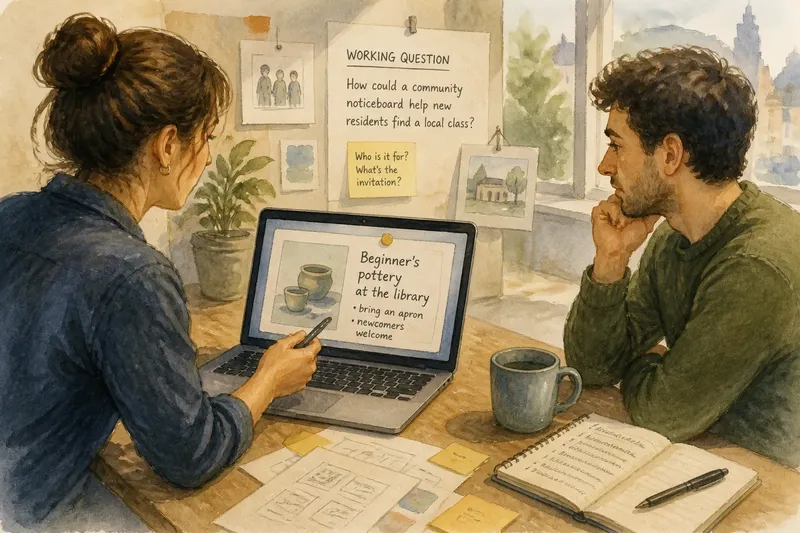
You have a rough sketch open on your laptop, and a colleague asks what you are working on. Sharing an unfinished idea can feel awkward: you want a useful response, but you do not want to pretend the work is settled. A five-minute walkthrough for sharing an unfinished idea gives the conversation a clear shape: name the question, show one example and ask for a particular kind of response.
The aim is not to pitch a finished solution. It is to make the live decision visible, so the other person can respond to the work that is actually in front of you.
1. Set a small time boundary
Start by saying how long you need. “Could I take five minutes to show you an idea I’m still shaping?” is enough. This gives the other person a sense of the commitment and gives you permission to keep the explanation focused.
A short boundary also helps separate the walkthrough from a general conversation about the project. You are not asking for every possible thought, nor promising to act on each suggestion. You are making room to examine one part together.
If the other person is busy, ask when would suit them instead. A hurried audience is unlikely to give the idea the attention it needs, and you need not treat a delayed conversation as a verdict on the work.
Agree on the time before you open the slides, notebook or prototype.
2. Name the question that is still open
Give the idea a plain-language question. It might be, “How could a community noticeboard help new residents find a local class?” or “Can this story begin with the object rather than the narrator?” A question points to the part you are exploring without implying that you have already answered it.
Make the question narrow enough to discuss in one sitting. “Is this good?” invites a vague judgement. “Does the first panel make the intended audience curious enough to read the second?” gives someone a place to begin.
Then add one sentence of context: who the idea is for, or what prompted it. Keep the background to what the listener needs to understand the question. If the history of the project matters, offer it after the example rather than leading with a long account.
For instance, you might say, “I’m exploring whether a noticeboard could make local classes easier to discover for people who have just moved here.” The question gives the conversation a useful centre.
3. Show one concrete example
Choose a single piece of the idea that someone can see, hear or imagine clearly. For a service, that could be a sample listing. For a story, it could be a paragraph. For a workshop, it might be the opening activity written on a card.
Resist the urge to show every branch. A handful of alternatives can prompt people to compare options before they understand the problem. One example keeps attention on the question and makes it easier to discuss what the idea might do.
Say you are considering a noticeboard for new residents. You could show one invented sample card: “Beginner’s pottery at the library; bring an apron; newcomers welcome.” Then explain that the card is there to test whether a clear activity, place and invitation make the listing easier to understand. The example is a conversation aid, not evidence that the larger idea already works.
Make the example legible. Enlarge a small sketch, read a short passage aloud, or point to the part you want the listener to notice. If a detail is deliberately rough, say which one; otherwise, a listener may spend the conversation correcting something you never meant to settle.
4. Ask for the response you need
Tell the listener what sort of response would help. You could ask them to say what they understand, where they become confused, or what question the example leaves them with. These requests make it easier to respond honestly without turning the exchange into an all-purpose critique.
Be clear about the kind of feedback you do not need yet. If you are still deciding whether the central idea is understandable, comments on colours, wording polish or production details may pull attention away from that decision. You can invite those comments later, once they are relevant.
For example: “Could you tell me what you think this card is inviting someone to do, and where you hesitate? I’m not looking for copy edits yet.” That request leaves room for a candid answer while setting a helpful boundary.
If you are unsure what to ask, choose one of these prompts:
- “What do you think this idea is trying to make easier?”
- “Which part feels unclear or incomplete?”
- “What would you expect to happen next?”
- “What question should I explore before I build on this?”
Ask one main question, then listen without defending every choice.
5. Let the listener respond before you explain
After showing the example and asking your question, leave a little quiet. It can be tempting to fill the pause with extra context, especially when the idea feels personal. But a quick explanation of what the listener should notice can prevent you from hearing what they noticed on their own.
Listen for the distinction between a reaction and a decision. “I like the colours” is a reaction. “I can’t tell whether newcomers or class organisers are meant to use this” points towards a decision about audience. Both may be worth hearing, but the second connects more directly to the stated question.
If a response seems off-topic, bring it back gently: “That could matter later. For now, could we stay with whether the invitation is clear?” This is not dismissing the person; it is protecting the purpose of the short conversation.
6. Reflect back what you heard
Before you close, say what you understood from the response. “You could tell the card described a class, but you weren’t sure who could attend” is more useful than a quick “Thanks, that helps.” It gives the listener a chance to correct your interpretation and makes the conversation easier to remember.
Do not turn their comment into an immediate promise. You might say, “I’ll consider whether the audience needs to be clearer,” rather than “I’ll change the whole concept.” A suggestion is information to weigh, not an instruction you must follow.
Keep a brief note of the question, the example shown and the response you heard. A notebook or a note beside the draft is enough. This gives you a record of what prompted the next revision without making the conversation feel like a formal review.
7. Choose one next move
Finish by naming a modest next action: rewrite the question, make a second sample card, or show the same example to someone who knows the intended audience. The action should follow from the response, while leaving the idea open to change.
Imagine the listener says the sample card describes the activity but not whether beginners are welcome. Your next move might be to draft a version that makes that invitation explicit, then consider whether it answers the original question more clearly. You do not need to decide the entire noticeboard’s design in that moment.
If the feedback does not settle the question, that is still useful. You can write down what remains uncertain and decide whether another conversation, a different example or more thinking would help. The goal is a clearer next question, not forced agreement.
What should you say when you share an unfinished idea?
How do I introduce an unfinished idea without apologising?
State that the idea is in progress, then name the question you are exploring. You can be candid about what is undecided without calling the work bad or asking the listener to reassure you.
What if I do not have a polished example?
Show a rough sketch, a sample sentence or a spoken description that makes one part concrete. Tell the listener which details are still provisional so they can respond to the idea rather than mistake a rough finish for a settled choice.
How do I stop the discussion becoming a general critique?
Ask for one kind of response and repeat the open question if the conversation wanders. You can note useful side comments for later without trying to resolve all of them in the same meeting.
What if the response is mostly praise?
Thank the listener, then ask a more specific follow-up, such as what they think the example is inviting someone to do. This gives them a clearer route to offer detail without requiring them to invent criticism.
Keep the invitation smaller than the idea
A five-minute walkthrough for sharing an unfinished idea works best when you bring one live question, one example and one request for feedback. That small invitation makes it easier for someone to help without asking them to judge the whole project.
Before your next conversation, write the question on a slip of paper and place it beside the example you plan to show. If the two do not seem connected, revise the question or choose a clearer example. That simple check can make the exchange more focused before either of you says a word.