A Time Limit or a Materials Limit?
A time limit or materials limit can turn a loose creative idea into focused work. Choose the boundary that removes your real obstacle and keep making.
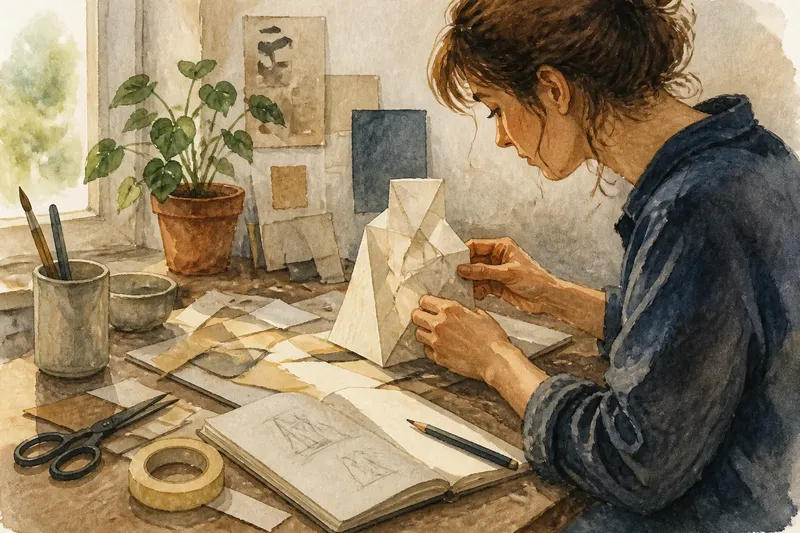
You have a half-formed idea for a small paper sculpture, but the afternoon is already filling with errands. A time limit might help you begin before the day disappears. If you have hours but only scrap paper, tape and a blunt pencil, a materials limit may be the more useful boundary. Choosing between a time limit or materials limit starts with spotting what is actually getting in your way.
Both boundaries narrow the field, but they do different jobs. Time limits contain duration: they ask you to work within a defined session. Materials limits contain resources: they ask you to make something with a defined set of tools or ingredients. The wrong one can add pressure without resolving the problem. The right one can make the next decision easier.
Choose the boundary that meets the obstacle
Start by finishing this sentence: “I’m not moving forward because…” If the honest answer is “I keep postponing the work” or “I can’t stop adjusting it”, time is probably the difficulty. If it is “I keep searching for better supplies” or “there are too many ways to make this”, consider limiting materials.
A time boundary is useful when the work needs a start, a stopping point or a deliberate change of pace. It can keep a sketch from swallowing the whole evening, or give a hesitant writer permission to make a rough first pass. It does not need to mean rushing. A session can be long enough to settle into the work and still have a clear end.
A materials boundary is useful when choices are multiplying or the ideal tools are unavailable. Limiting a collage to found paper, for example, shifts attention from shopping to arranging. A poet might use only a notebook and pencil rather than opening several apps and reference tabs. The point is not deprivation; it is to make a workable field of choice.
Choose one main boundary at first. If your difficulty is unclear, use the smallest change that addresses it rather than imposing both restrictions at once.
A time limit feels like a race
This usually happens when the session is too short for the kind of work you chose, or when you treat the clock as a measure of how much you ought to produce. A timed session is meant to contain the work, not grade it. If you are trying a new medium, a brief slot may be spent simply finding your bearings.
Try matching the session to the task’s scale. For a loose writing pass, give yourself enough uninterrupted time to draft a paragraph or follow one line of thought. For a fiddly model, allow room to gather the pieces and test a connection. You do not need a precise formula. Ask what a useful attempt could look like, then choose a session that leaves room for it.
It also helps to decide what the timer means before starting. It might mean “stop making new marks and look at what is here”, rather than “finish the piece”. That small distinction can lower the pressure while preserving an endpoint. If you reach a promising point as the session ends, jot down the next action before you put the work away.
Set an ending that protects attention, not one that turns every minute into a deadline.
The session ends but nothing feels finished
That can be a mismatch between the boundary and the aim. A time limit controls how long you work; it cannot make an open-ended idea resolve on schedule. If you expect a complete song, story or object in one sitting, the timer may make ordinary uncertainty feel like failure.
Give the session a smaller purpose: collect three possible openings, draw the shape from two angles, or test whether a scene works in dialogue. These are useful outcomes even when the larger piece remains unfinished. A boundary works better when it shapes the attempt, not when it demands a finished result.
Imagine you have been circling a story about a neighbour’s noisy greenhouse. You set aside a quiet session to write the whole story, then stall because the ending is unclear. For the next attempt, you choose a contained session to draft only the moment when the narrator first hears the glass rattle. The observable result is a scene on the page and a clearer sense of what still needs deciding, not a promise that the story is complete.
If finishing is genuinely the immediate need, make the task smaller before making the timer stricter.
A materials limit leaves you without a useful tool
This often means the boundary was chosen for its toughness rather than its relevance. “Use only what is in the room” can be a lively constraint, but it can also remove something essential to the work. A paper-cut design may need scissors; a sound sketch may need a way to record. A limit that blocks the basic action is not simplifying the task.
Separate essentials from conveniences. Essentials let you attempt the idea; conveniences make it more comfortable or polished. Keep the essentials, then limit the rest. For a drawing, that might mean a pencil and one sheet of paper, while leaving the full box of markers aside. For a small audio piece, it might mean one recording device and a single sound source instead of a collection of instruments.
When the boundary feels like a puzzle with no answer, loosen it by one useful item. You are looking for enough resistance to prompt decisions, not so much that every decision becomes about overcoming a shortage.
Keep what lets the work happen; restrict what only multiplies options.
You keep changing the limit instead of making
It is easy to spend a session revising the rules: a shorter timer, fewer colours, a more severe restriction. That can feel like preparation, but often it delays the uncertain part, which is making something. The boundary is a container, not the creative work itself.
Write down the rule in one plain sentence before you begin. For instance: “I’ll sketch with charcoal and paper, then stop when the session ends.” If you notice a useful reason to adjust it, note that reason for next time rather than renegotiating every few minutes. A clear rule makes it easier to notice whether the boundary helps.
There is no need to make the limit impressive. A modest, understandable boundary is easier to follow and easier to assess afterwards.
Use a materials limit when the session still feels scattered
If you have started on time but keep switching tools, hunting for supplies or reconsidering the medium, duration may not be the main issue. A materials limit can reduce those detours. Choose the supplies that already let you make a first version, then put the alternatives out of reach for that attempt.
For example, a person making a poster might choose a black marker, scrap card and glue rather than moving among a laptop, paint tin, coloured pens and saved images. The point is to make the next visual decision with the chosen materials. The result may be rough, but it gives the person something concrete to inspect before deciding what to change.
This boundary can also be helpful when access is limited. If you are working at a kitchen table, travelling with a small kit or sharing a studio, choosing materials that fit the setting can make the idea possible now. A constraint based on what is genuinely available is usually more useful than one designed to sound austere.
Which creative boundary fits this problem?
Should I choose a time limit if I keep procrastinating?
Often, yes, if the task is already clear and delay is the main obstacle. Set a defined session and decide on a small action to begin with, such as opening the document and drafting a rough first paragraph.
Should I limit materials if I have too many ideas?
Try it if the ideas keep multiplying because you are switching tools or possibilities. Choose a small set that can support the work, then make one version before bringing other options back in.
Can I use a time limit and a materials limit together?
You can, but introduce the second boundary only if the first leaves the same problem unresolved. For instance, a set session may help you begin, while a small set of supplies may later help you stop browsing and make choices.
What if neither boundary seems to help?
The obstacle may be a vague task rather than a lack of limits. Name one visible action—such as sketching a doorway or drafting a single exchange—and see whether that makes the work easier to enter.
Review the boundary before choosing another
After the attempt, ask a few practical questions: Did I begin more readily? Did I spend less time choosing? Did the limit interrupt a useful line of thought? Did I leave with a next action? You do not need to judge the work as good or bad to answer them.
If the timer helped you start but made the session feel hurried, keep the time boundary and allow a more generous working stretch next time. If a materials limit reduced indecision but made a necessary technique impossible, add back the tool that supports that technique. Change one thing at a time so you can tell what needs adjusting.
When you are unsure which to use, return to the original obstacle. Choose a time limit when duration is the trouble; choose a materials limit when resources or options are. A time limit or materials limit is most useful when it gives the work a clearer next move, then gets out of the way.