Why a Short Prompt Can Open a Stuck Page
A short prompt can open a stuck page by narrowing your first choice, giving you a manageable place to begin while leaving the finished work yours.
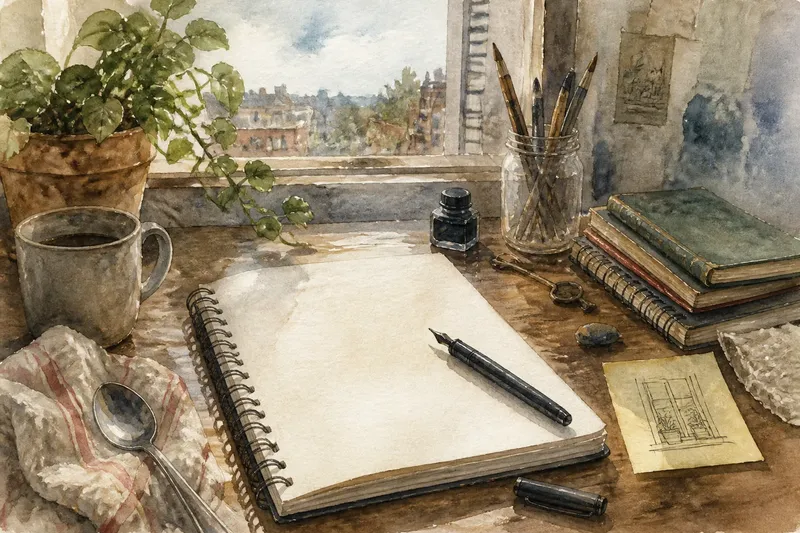
Your notebook is open, the pen is uncapped, and the blank page seems to ask for everything at once. A short prompt can open a stuck page by giving your attention one small place to land, without deciding what the finished work must become.
A useful prompt is not a miniature plan. It is a starting handle: a few words that reduce the number of possible first moves. You can use one for a poem, a drawing, a scene, a song idea or any other work that feels too open to begin.
Notice what is making the page feel difficult
Before choosing a prompt, name the snag in plain language. Perhaps you cannot choose a subject. Perhaps you have a subject but cannot find an opening image. Or perhaps you are trying to make the first line sound finished before it exists.
That distinction matters because a prompt should narrow the particular choice holding you up. “Write a poem” does little for someone who already knows they want a poem but cannot find a first image. “Describe a cup left beside a sink” offers a visible place to begin.
Write down the stuck point in a short phrase, such as “too many subjects” or “no opening image”. Keep it simple. The aim is to choose a useful entry, not to diagnose your creativity.
Choose one small doorway into the work
Pick a prompt that gives you a concrete first move. A useful prompt often names one of these:
- An object: a cracked saucer, a red mitten or a paper ticket.
- A place: a stairwell, a bus shelter or the corner of a kitchen table.
- An action: someone folds a note, misses a turn or waters a plant.
- A sensory detail: a warm handle, a faint rattle or the smell of wet pavement.
- A point of view: a scene as seen by a waiting dog or an overlooked object.
Choose one doorway, not a bundle of them. If you combine a setting, a character, a secret, a mood and a required ending, you have begun outlining a whole piece. That may be useful later, but it can weigh down a first prompt when you are stuck.
Say you want to draw but keep switching subjects. You choose “a spoon on a folded tea towel” and begin with the spoon’s outline. The expected result is a few marks on the page and a clearer sense of whether you want to continue with that object or take the drawing elsewhere.
Make the prompt narrow without making it a rulebook
Make the prompt specific enough to suggest a first action, but loose enough to allow several outcomes. “A letter arrives” could lead to a scene, an image, a memory or an abstract composition. “Write a letter from a lighthouse keeper to a lost twin, in rhyme, ending with a confession” has already made many creative decisions for you.
Check the balance with two questions: can I begin immediately, and can I still surprise myself? If you cannot answer yes to the first, add a concrete noun or action. If you cannot answer yes to the second, remove a requirement.
Keep the prompt in a margin, on a sticky note or at the top of the page. It should be easy to see, but it does not need to govern every line or mark.
Begin with a small, visible response
Respond to the prompt in the simplest form available. For writing, make a plain sentence or a list of details. For drawing, put down a rough shape. For music, hum a phrase or mark a rhythm. For a craft idea, sketch an outline or gather a few relevant materials.
Do not ask this first response to be impressive. Its job is to turn an imagined possibility into something you can look at. Once there is a sentence, mark or sound, you have new information: perhaps the image feels lively, perhaps it feels flat, or perhaps it points towards a different subject.
If you cannot start, shrink the action rather than adding more plot. Replace “write the scene” with “write what the character can hear”. Replace “draw the room” with “draw the edge of the table”. A smaller opening can still lead to a larger piece.
Let the work answer back
After making an initial response, pause and notice what it suggests. A prompt is a door, not a corridor with only one route. Follow a detail that catches your attention, even if it was not part of the original wording.
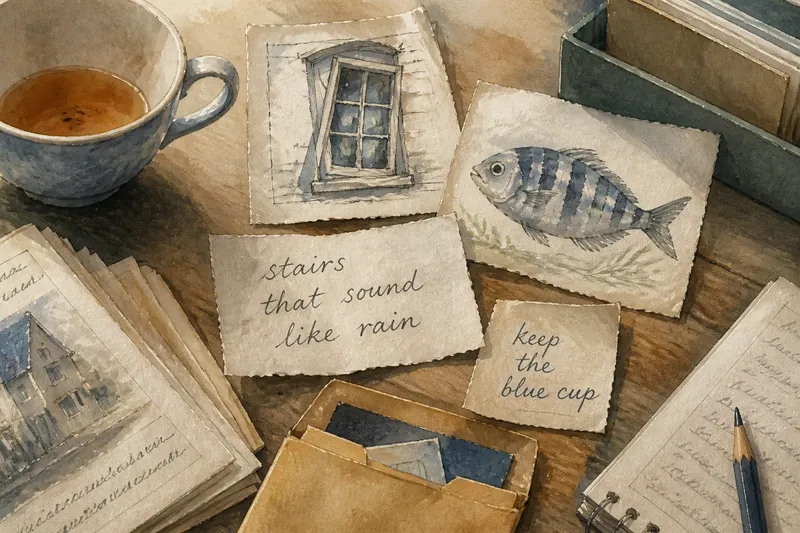
For instance, if “a key on a windowsill” leads you to write about dust rather than a locked door, stay with the dust for a little while. You are not failing to follow the prompt. You are discovering which part of it has energy for you.
At this point, you can leave the prompt behind, alter it or use it again. If it has done its job, the work now has its own next question.
How can you adjust a prompt that is not helping?
How can you make a vague prompt easier to use?
Add one concrete object, place or action. “Write about change” might become “describe a plant bending towards a window”, which gives you something visible to begin with.
Should a prompt tell you what the finished work will be?
No. It should make a first move available, not prescribe the ending, message or form. Leave those choices open until the work gives you a reason to make them.
What if you do not like what you make?
Keep the attempt long enough to see what it contains, then decide what to keep. You can discard the prompt, carry one image into a new piece or simply use the page to get moving.
Can one prompt be used for different kinds of work?
Yes. “A door left ajar” could begin a paragraph, a thumbnail drawing, a stage image or a melody with an unresolved phrase. The prompt stays small while your chosen form shapes the response.
Keep a prompt that helps you begin
When you find a prompt that gets you moving, save its wording and note what kind of starting point it offered: an object, an action, a sound or a place. This gives you a modest set of entry points to return to when another page feels crowded with possibilities.
A short prompt can open a stuck page because it gives you one decision to make now, instead of demanding a decision about the whole piece. Choose a detail you can respond to, make a first mark or sentence, and let the work decide what comes next.