How Idea Collections Turn Separate Fragments into New Work
Idea collections help you combine sketches, phrases and observations into fresh creative directions while keeping useful fragments open to revision.
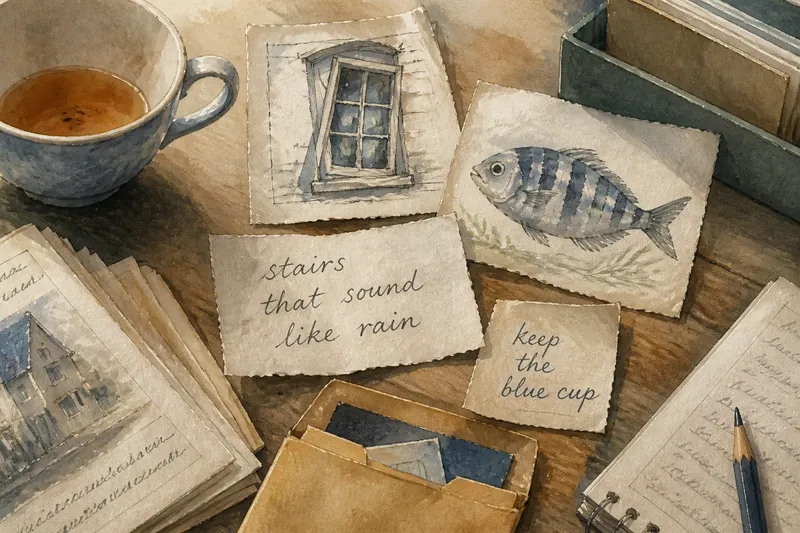
A crooked window, a striped fish and the phrase “stairs that sound like rain” sit on separate scraps beside a half-empty cup of tea. Together, they make an idea collection: a place where fragments from different sources can meet before you know what they might become.
Idea collections have long joined different kinds of material
There is no single history of the sketchbook. A bound book has offered a portable way to keep notes and drawings together, but collections have also taken the form of albums, loose sheets, cabinets and commonplace books. The materials and habits varied by person and purpose; it is safer to think of these as related practices than as one unbroken tradition.
Commonplace books, for example, were organised around copied passages and notes rather than being limited to sketches. Their owners could gather words, observations and other material for later reference. Albums offered another kind of arrangement: images and written keepsakes could sit side by side, with the page itself shaping how they were seen.
Artists’ and writers’ working collections likewise need not be a record of one project. A drawing might sit near a copied pattern, a street observation or a phrase heard in conversation. The meaningful act is not simply keeping things; it is choosing what to keep and letting one item alter how another is noticed.
Separate fragments can combine without losing their origins
A loose idea is easier to adapt when it has not already been assigned a fixed role. “Rain-like stairs” can be a sound, a setting or a character’s private comparison. If it is labelled as a particular scene too soon, other uses may be harder to see.
Keep a small note of where a fragment came from when that context matters. “Heard the radiator click in the kitchen” preserves an observation; “mysterious sound for chapter three” turns it into an instruction. The first leaves room for a later connection.
Combining does not mean forcing every scrap into the same project. Try a pairing, notice what changes, then separate the pieces if the relationship feels thin. Curiosity is a better reason to keep a connection than a duty to use everything.
A simple arrangement can reveal a useful connection
Imagine you have four invented starting fragments: a sketch of a crooked window, a striped fish, the phrase “stairs that sound like rain”, and a note saying “keep the blue cup”. You want to begin an illustrated story, but have no plot yet.
First, place the scraps together on a table without assigning them roles. The window and fish suggest a visual pairing; the stairs and rain suggest a sound. Next, ask what sort of place could contain both. You choose an old boarding house, where a child keeps a blue cup on the sill and hears the stairs creak during storms.
Then write a short scene around the sound: the child hears someone climbing but cannot see who is coming. On rereading it, you decide the sound creates tension, while the fish and cup still feel decorative. Keep the sound with the draft, move the other scraps into a “possible” envelope, and leave the window sketch available for another arrangement. The result is a clear decision about the scene’s current focus, not a claim that the remaining pieces must be used.
Choose a format that makes rearranging easy
A collection should help you return to material, not make every fragment feel like a filing job. Choose a format that suits the way you work.
- Bound notebook: Check whether you want to preserve sequence; if the order matters, keep notes and drawings together on dated pages, but if you need to move fragments freely, use loose cards instead.
- Folder or envelope: Check whether the pieces are physically removable; if you often regroup them, sort them into labelled pockets, but if they are too small or fragile to handle, mount them on backing sheets.
- Tabletop or wall: Check whether size, colour or distance changes what you notice; if it does, arrange the pieces where you can see them together, but if the space is temporary, photograph the layout before clearing it.
- Digital board: Check whether you can add and find images, notes and links without losing their sources; if you can, keep a short source note with each item, but if the board becomes difficult to search, use dated folders or a simpler notes app.
- Context notes: Check whether you can still recall why a fragment caught your attention; if not, add a brief observation, but if the note starts prescribing its meaning, keep only the original context.
- Review space: Check whether duplicates or unreadable scraps make browsing harder; if they do, remove them or move uncertain items to a separate envelope, but if an item still prompts a question, leave it in the active collection.
Keep the arrangement provisional. A photograph of a tabletop grouping can preserve the connection while the original pieces return to their separate homes.
What should you keep, combine or set aside?
Does every fragment need to belong to a project?
No. A scrap can remain in the collection because it still interests you, even if you have no project for it. Leaving it unassigned makes later combinations possible.
How much should you write beside an idea?
Record enough to recognise the source or circumstance, such as where you saw a reflection or heard a sound. Avoid explaining the fragment so fully that you close off other interpretations.
When should you remove a fragment?
Consider removing material that is duplicated, unreadable or no longer worth revisiting. If you are unsure, set it aside in a temporary envelope and decide when you next browse the collection.
Can a digital board serve as an idea collection?
Yes, if it lets you add, find and rearrange material without obscuring where it came from. A notes app, dated image folder or visual board can each work; choose the one you are likely to revisit.
Revision can keep a collection open without making it endless
Revisiting a collection is not the same as judging every fragment. Remove duplicates, clarify a note that no longer makes sense, or move an item to a different pocket when its role changes. Keep completed work elsewhere if you want the collection to remain a place for unsettled material.
For an idea collection, a useful balance is simple: preserve enough context to remember what caught your eye, and leave enough room for the fragment to change. The blue cup may never enter the story, while the rain-like stairs may become its defining sound. Either way, the next visit to the folder should make a new arrangement possible.